
How the Ear Works
Did you know that the ear is the first organ to be fully formed in the mother's womb, and the last to accompany us until our last breath?
Discover with ODYO this extraordinary little organ, at the heart of our lives from our very first moments.
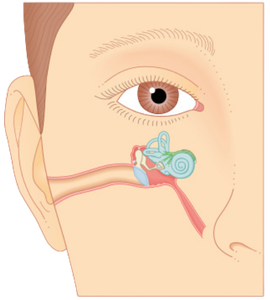
The Ear sits below the Eye
Perpendicular to the external auditory canal and the eye, lies the ear, the organ responsible for hearing and balance.Anatomy of the Ear
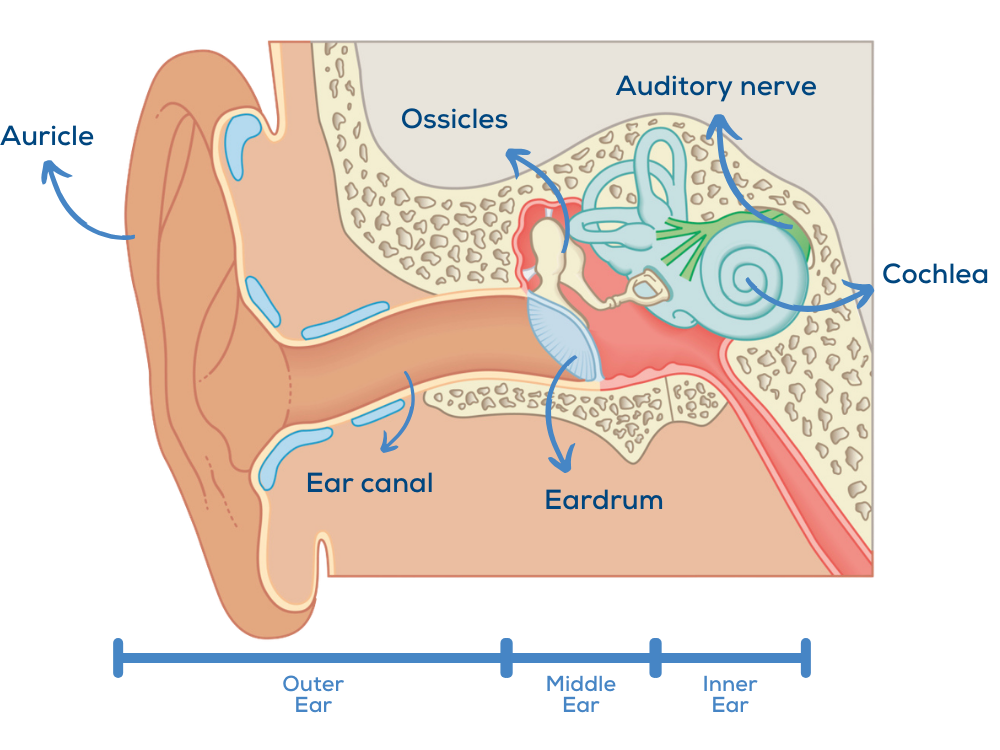
The ear is a surprisingly complex organ. Partly housed in the temporal bone of the skull, it has two essential roles: to enable us to hear and to help us keep our balance. To better understand it, we divide it into three parts: the outer ear, the middle ear and the inner ear.
The Outer Ear
-
the pinna, the visible part of the ear
-
the external auditory canal
Their main role is to protect the eardrum. The pinna is made of skin-covered cartilage, located on either side of the head. Its shape acts like a natural funnel. It picks up sound waves and helps locate the origin of sound.
The external auditory canal, about 2.5 cm long, carries sound to the middle ear and eardrum. It's lined with tiny hairs and glands that produce cerumen (earwax).
Cerumen contains substances that fight infection and protect the skin of the ear canal. It also traps dust and foreign particles to keep the ear clean and protect the more fragile structures deeper down.
The Middle Ear
The second part of the ear is called the middle ear. It's a small air-filled space separated from the outer ear by a thin membrane: the eardrum.
When sound waves travel through the external auditory canal, they hit the eardrum, also known as the tympanic membrane. This thin, very taut and sensitive piece of skin vibrates at the slightest change in pressure caused by sound.
-
the hammer (malleus), directly attached to the eardrum
-
the incus, the intermediate bone
-
The stirrup (stapes), the smallest bone in the human body, connected to the inner ear
Together, these ossicles increase vibrations from the eardrum and transmit them to the inner ear, where they are converted into nerve signals.
The middle ear also communicates with the throat and nose via a canal called the Eustachian tube. This canal balances the air pressure on either side of the eardrum, allowing it to function optimally. It is responsible for the sensation of blocked ears when taking off from an airplane, for example.
The Inner Ear
The final part of the ear is the inner ear. It comprises three interrelated structures that work together. The vestibule and semicircular canals help maintain balance. The cochlea is responsible for hearing.
The cochlea is a liquid-filled, snail-shell-shaped organ. Its main role is to transform the mechanical vibrations of the middle ear, caused by sound waves, into electrical impulses that the brain can understand as sound.
Here's how it works:
Vibrations transmitted by the ossicles reach the cochlea through the oval window, setting the internal fluid in motion. These waves travel to the round window at the other end of the cochlea, where they stimulate tiny ciliated nerve cells located on the basilar membrane in the organ of Corti (the true center of hearing). Depending on their position in the cochlea, these cells create electrical signals specific to each pitch (tone), which are sent to the brain via the auditory nerve.
Hair cells are very fragile and do not regenerate in humans. Prolonged exposure to loud noise gradually and irreversibly damages them. This is the main cause of noise-induced hearing loss.
The inner ear is the most complex and best-protected part of the ear, housed deep within the temporal bone. It is divided into two major systems:
-
The cochlea: for hearing
It picks up sounds and transforms them into electrical messages that the brain interprets as sound. - The vestibular system: for balance
The inner ear contains three semicircular canals oriented in three directions (like the x, y and z axes). Filled with liquid, they detect head movements and rotations. Two other structures, the utricle and saccule, perceive linear movements and the position of the head in relation to gravity. Together, these elements form our balance system, which works continuously with the eyes and muscles to keep us stable.
From Sound to Brain in Milliseconds
When a sound reaches your ear, here's what happens:
-
The auricle / pinna picks up the sound waves.
-
They pass into the ear canal and vibrate the eardrum.
-
The three ossicles amplify these vibrations and transmit them to the oval window of the cochlea.
-
The stapes set the fluid inside the cochlea in motion.
-
These movements create waves in the fluid that stimulate nerve cells in different parts of the cochlea, which are sensitive to specific frequencies (pitches).
-
The hair cells transform these movements into electrical impulses, and this is where the acoustic signal is "born".
-
The cochlear nerve (auditory nerve) carries these impulses to the brain.
-
The upper auditory pathways ensure proper transmission of information and help the brain to analyze and recognize sound.
-
Meanwhile, pressure waves in the liquid continue to the round window, which acts as a pressure equalizer in relation to the oval window, moving outwards as the oval window moves inwards, and vice versa.
All this takes place in a fraction of a second. Yet each step is essential: a disturbance at any level can lead to hearing loss, whether mild, moderate or severe.