

What Are Ear Canal Exostoses and Osteomas?
The external auditory canal is a narrow passage, lined by skin, made partly of cartilage and partly of bone. Exostoses and osteomas arise from the bony portion of this canal.
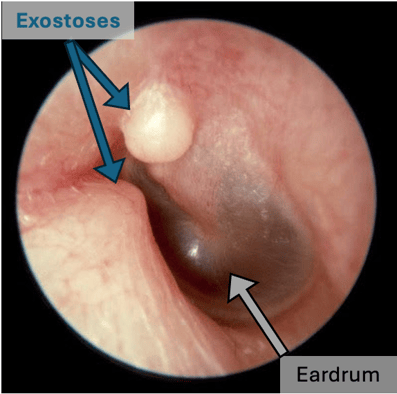
Exostoses are reactive bony overgrowths. They are not true tumors but rather a response of bone to repeated irritation, most commonly cold exposure. Over time, the bone at certain areas thickens as an inward bulge, reducing the opening of the ear canal, and creating a bony growth. These growths tend to be smooth, widely-based, and multiple. They most often affect both ears and are commonly referred to as “surfer’s ear.”
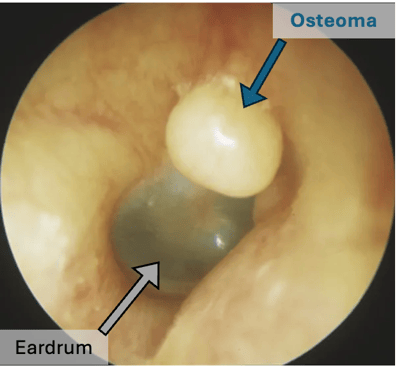
Osteomas are true benign bone tumors. They typically grow as a single, well-defined bony lump that grows from one specific spot in the ear canal. They tend to occur in only one ear. Unlike exostoses, osteomas are not considered a reaction to environmental exposure.
Both conditions are benign, meaning they do not spread and do not turn into cancer.
How Do They Present? Clinical Symptoms
Most patients have no symptoms at all, and only learn about them during an ear examination by a physician, or during routine wax removal. I often see patients who were initially told they had “ear lesions” or “ear cysts” by their primary care provider or another physician. During the ear exam, I identify these as exostoses instead. Most patients feel relieved when they receive this accurate diagnosis.
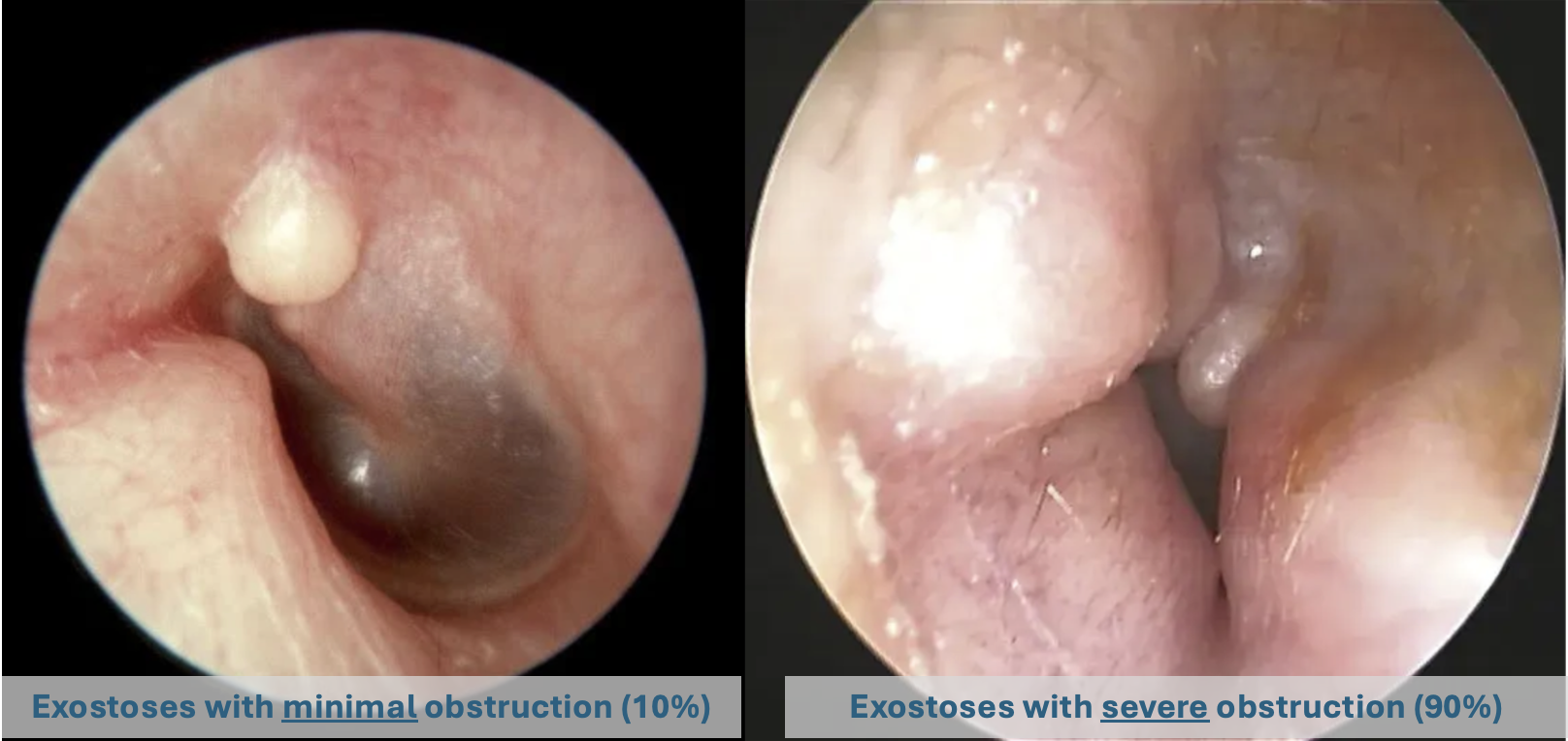
When symptoms develop, they are usually caused by mechanical blockage of the ear canal. As the canal narrows, earwax, skin debris, and water are more easily trapped behind the bony growth. This can lead to a feeling of fullness or blockage in the ear, especially after swimming or showering. Patients often report that water takes a long time to drain from the ear. To learn more about ear fullness, you can read this article.
Recurrent outer ear infections (otitis externa) are common in more advanced cases, as trapped moisture creates an ideal environment for bacterial or fungal growth. Temporary hearing reduction may occur when the canal becomes significantly obstructed by wax or swelling. Read this article to learn more about ear infections.
Pain is not a typical feature unless an infection is present. Tinnitus (ringing in the ear) and dizziness are uncommon and usually suggest another diagnosis. This article explains ear pain in more detail.
How Do Exostoses and Osteomas Differ Clinically?
Although both are bony growths of the ear canal, they differ in appearance, behavior, and underlying cause.
Exostoses usually develop slowly over many years and are often found in individuals with long-term exposure to cold water or wind. They are commonly bilateral (affecting both ears) and tend to be symmetrical. On examination, they appear as multiple smooth, rounded bony prominences that narrow the canal from several directions.
Osteomas typically present as a single lesion in one ear. They often arise from a specific point in the ear canal. Their growth is usually very slow, and they may remain stable for years. They are not linked to cold water exposure and often appear without an obvious cause
In most cases, an experienced clinician can distinguish between the two based on history and physical examination alone.
Pathophysiology: Why and How Do These Growths Develop?
The development of exostoses is best understood as a protective response. Repeated exposure to cold water or cold air causes chronic irritation of the periosteum (the thin membrane covering bone). This irritation stimulates new bone formation as a defensive mechanism, gradually thickening the ear canal walls. The colder and more frequent the exposure, the higher the risk and severity. This explains why exostoses are common in surfers, divers, kayakers, and individuals living in cold, windy coastal environments.
Osteomas, in contrast, are true bone tumors. Their exact cause remains unclear. They are thought to result from abnormal localized bone growth rather than environmental factors. Genetics, prior trauma, or developmental anomalies have been proposed, but no definitive cause has been established.
Is Any Medical Work-Up Needed?
In the vast majority of cases, no medical work-up is required.
Diagnosis is typically made through a detailed medical history and careful ear examination using an otoscope or microscope. The clinician will determine the size of the growth, the degree of ear canal narrowing, and the presence of trapped debris or infection.
Hearing tests (audiograms) are generally not necessary unless the patient reports persistent hearing loss that does not improve after ear cleaning or treatment of infection. To learn more about audiograms, read this article.
Imaging, such as a CT scan of the temporal bone, is rarely needed. It is usually reserved for cases where surgery is being considered (even in such cases, a scan is not always needed), if the anatomy is unclear, or there if there is concern about other ear pathology.
Treatment Options and When Surgery Should Be Considered
For most patients, no treatment is necessary. Observation and periodic ear cleaning by a healthcare professional are often all that is required.
This includes monitoring and professional ear cleaning to prevent wax accumulation and infections. Patients are often advised to avoid aggressive self-cleaning, which can worsen symptoms or cause injury.
Surgical treatment is considered when symptoms significantly affect quality of life. Indications include frequent or difficult-to-treat ear infections, repeated blockage requiring medical visits, significant hearing impairment due to canal obstruction, or near-complete closure of the ear canal.
The surgery is called "canalplasty" and involves carefully removing the bony growths with a surgical drill to widen the ear canal. Care must be made to preserve the skin of the ear covering the bony growths. This procedure is technically demanding and should be performed by an experienced ear surgeon. Outcomes are generally excellent, with significant symptom relief.
Regarding recurrence, exostoses may regrow if the patient continues cold water exposure without protection. Osteomas, once completely removed, rarely recur.
Prevention: What Can Be Done to Reduce Risk?
Prevention is particularly important for exostoses.
Regular use of ear protection — such as custom or silicone earplugs — during cold water activities can significantly reduce irritation to the ear canal bone. This not only lowers the risk of developing exostoses but can also slow progression in patients who already have early changes. To learn more about the types of ear protection, read this article.
Drying the ears gently after water exposure and avoiding repeated cold exposure without protection are practical preventive measures. Drying the ear can be done using the "cold setting" of a hair dryer aimed at the ear (while pulling the ear backwards with the other hand to open the ear canal). Another solution would be to use drying solutions, such as those containing peroxide. A few drops will help evaporate the trapped water. For more information on ear hygiene, read this article.
Unfortunately, there are no proven preventive strategies for osteomas, as their cause is not related to environmental exposure.

Joe Saliba, MD
Dr. Joe Saliba is an ENT surgeon specialized in neuro-otology and medical director at ODYO. He treats patients with various ear and skull base disorders, ranging from hearing loss and vertigo to vestibular schwannomas and cochlear implants.