

1. What Is a Personal Sound Amplification Device?
A personal sound amplification product, usually abbreviated as PSAP, is an electronic device that picks up sound, processes it, makes it louder, and delivers it to the ears.
Some look like hearing aids. Others look more like headphones or Bluetooth earbuds. A common design is a small handheld device with a microphone connected to headphones or earbuds.
Their main advantage is simplicity. You turn the device on, adjust the volume, and listen.
However, modern personal amplifiers can be considerably more sophisticated than the old-fashioned “pocket amplifier.” Some now include digital noise reduction, directional microphones, Bluetooth, adjustable bass and treble, rechargeable batteries, and even smartphone-based hearing customization.
This has created a grey zone between inexpensive sound amplifiers and modern hearing aids. They may use some of the same technology, but they are not necessarily regulated, programmed, or intended in the same way.
In the United States, PSAPs are considered consumer electronic products rather than hearing aids. Their intended purpose is to improve hearing in selected situations rather than to treat hearing loss. Learn more about hearing loss.
2. How Does a Personal Amplifier Actually Work?
Every personal amplifier has the same basic pathway:
Sound → microphone → digital processor → amplifier → speaker or earphone → ear
The differences between products occur mainly in what happens between the microphone and the ear.
2.1 The Microphone Picks Up the Sound
The microphone converts sound waves into an electronic signal.
In a very simple amplifier, everything picked up by the microphone is amplified. The voice you want to hear becomes louder, but so does the air conditioner, traffic, dishes, and surrounding conversation.
Better devices try to make speech easier to hear while reducing some unwanted background noise.
2.2 The Device Changes the Volume
The simplest products provide approximately the same amplification across many frequencies.
More advanced personal amplifiers provide frequency shaping. This means they can amplify high-pitched sounds more than low-pitched sounds, or vice versa.
This matters because hearing difficulty is rarely equal across every frequency.
A tone or bass-and-treble control is therefore much more useful than a volume control alone.
2.3 Better Devices Control Loud Sounds More Effectively
Some devices increase quiet sounds more than sounds that are already loud.
This helps prevent a sudden noise from becoming excessively loud or uncomfortable.
Modern hearing aids use sophisticated systems to do this. Some higher-quality personal amplifiers use a simpler version of the same principle.
2.4 Some Devices Reduce Background Noise
Digital noise reduction tries to recognize relatively constant sounds, such as a fan or engine, and reduce them while preserving speech.
This does not completely eliminate background noise. No device can perfectly separate one conversation from several other people talking nearby.
However, good processing can make listening more comfortable.
2.5 Directional Microphones Can Be Very Useful
A directional microphone places more emphasis on sound coming from one direction, usually in front of the listener.
This can make the voice you want to hear stronger compared with the surrounding noise.
This can be useful in restaurants, meetings, and group conversations.
2.6 Moving the Microphone Closer Can Be Even More Important
One of the most useful features of some personal amplifiers is very simple: the microphone can be placed closer to the person speaking.
Imagine sitting across a table in a noisy restaurant. Making everything louder does not necessarily help because both the speaker and the restaurant become louder.
If the microphone is placed close to the speaker, however, their voice reaches the microphone much more strongly than the surrounding noise.
That can make a major difference.
This is why personal amplifiers and remote microphones can sometimes be very effective even though they are technologically simpler than expensive hearing aids.
3. Who Benefits Most From a Personal Amplifier?
Personal amplifiers are particularly useful when the hearing difficulty is situational rather than constant.
A person may hear reasonably well throughout most of the day but struggle in one particular setting.
Common examples include:
- watching television without increasing the volume for everyone else
- having a one-to-one conversation
- talking with a physician during a medical appointment
- hearing someone across a table
- conversations while driving in a car
- meetings or lectures
- visiting a family member in a hospital or long-term-care facility
- hearing a religious service or presentation
They can also be useful for someone who has difficulty manipulating very small hearing aids.
For example, a person with arthritis, reduced vision, tremor, or reduced hand dexterity may find a handheld amplifier with large buttons much easier to operate than two tiny hearing aids.
This can be particularly useful for elderly patients living in a residence or admitted to hospital. A caregiver can place headphones on the patient, turn on the amplifier, and immediately communicate more effectively.
For this type of occasional communication problem, a simple personal amplifier may actually be more practical than a sophisticated hearing aid.
4. Can They Help Someone Who Actually Has Hearing Loss?
Yes, sometimes.
This is where the terminology becomes slightly confusing.
Although PSAPs have traditionally not been marketed as replacements for hearing aids, clinical studies have tested them in people who do have hearing loss.
In a 2017 study of 42 older adults with mild to moderate hearing loss, several higher-quality PSAPs significantly improved speech understanding in noise. Three of the tested devices performed within five percentage points of a conventional hearing aid. In contrast, a very inexpensive basic amplifier actually made speech understanding worse.¹
A 2019 clinical study compared a PSAP with a basic hearing aid and a premium hearing aid. Among participants with mild or moderate hearing loss, there were no significant differences between the three devices on several measures, including speech perception, sound quality, and listening effort. However, people with moderately severe hearing loss generally performed better with the premium hearing aid.²
A 2022 systematic review and meta-analysis also found no significant overall difference between PSAPs and conventional hearing aids for several hearing outcomes. However, only five studies involving 124 patients were available, so the amount of evidence remained relatively limited.³
A more recent systematic review found an important distinction between different levels of PSAP technology. Premium PSAPs improved speech understanding in noise, while simpler basic PSAPs did not consistently provide the same benefit.⁴
These studies lead to an important practical conclusion:
The question is not simply whether personal amplifiers work. Some work very well. Others work poorly. The quality and design of the individual device matter enormously.
5. Personal Amplifier vs Professionally Fitted Hearing Aid
Both devices contain microphones, electronic processors, amplifiers, and speakers.
The major difference is how precisely the sound can be adjusted for the individual person. Explore how professionally fitted hearing aids work.
A modern hearing aid divides sound into multiple frequency ranges. Each range can be amplified differently.
For example, a person may need very little amplification for low-frequency sounds but considerably more amplification for high-frequency speech sounds.
A hearing aid can be programmed specifically for that pattern.
A simple personal amplifier with only a volume control cannot provide the same precision.
The advantage of a hearing aid is not simply that it amplifies more. It amplifies more selectively and more precisely.
Modern hearing aids can also coordinate information between the right and left ears, automatically recognize different listening environments, control feedback, change microphone directionality, and adjust their processing continuously.
For someone wearing amplification ten or twelve hours per day, these differences become important.
6. Personal Amplifiers vs Over-the-Counter Hearing Aids
This distinction can be particularly confusing because the products may look almost identical.
An over-the-counter hearing aid, or OTC hearing aid, is a specific regulatory category created in the United States.
It is intended for adults aged 18 years and older who believe they have mild to moderate hearing loss.
These products are actual hearing aids. They are medical devices, but the user can purchase and adjust them without first seeing an audiologist or physician. Read more about over-the-counter hearing aids.
Many use a smartphone application or a built-in hearing assessment to personalize the amplification.
A PSAP is different. In the United States, it is considered a consumer electronic product rather than a medical hearing aid.
There is an important Canadian difference.
Canada does not currently have a direct equivalent of the American nationwide OTC hearing-aid category.
In Canada, hearing aids are Class II medical devices regulated by Health Canada. Provincial rules can also affect how hearing aids are sold and fitted.
For Canadian consumers, this means that a website describing something as an “OTC hearing aid” does not automatically tell you how that product is classified or regulated in Canada.
When purchasing a device online, it is worth determining whether you are buying:
- a personal sound amplifier
- a consumer hearable
- a hearing aid approved for sale in Canada
- or an American OTC hearing aid being advertised to Canadian consumers
These are not necessarily the same thing.
7. When Is a Personal Amplifier Less Likely to Be Enough?
The more significant the hearing loss becomes, the more important precise amplification becomes.
A personal amplifier is less likely to provide satisfactory results when someone:
- needs amplification throughout most of the day
- has moderate-to-severe or severe hearing loss
- has very different hearing levels at different frequencies
- has poor speech understanding even when speech is loud enough
- frequently communicates in complex background noise
- needs reliable hearing from several directions
- requires precise amplification in both ears
- wants very small, discreet equipment for continuous use
Clinical studies support this distinction. People with mild to moderate hearing loss may perform quite well with a good-quality PSAP, while the advantage of more advanced hearing aids becomes greater as hearing loss becomes more severe.²–⁴
A common complaint illustrates the problem:
“I can hear everything louder, but I still cannot understand what people are saying.”
That usually means simply increasing volume is no longer enough.
8. Are Personal Amplifiers Safe?
Generally, yes, provided they are properly designed and the volume is used responsibly.
The biggest concern is excessive sound output.
Some amplifiers can produce very high sound levels. More power is not necessarily an advantage.
When using a personal amplifier:
- start at a low volume
- increase the volume only until speech is comfortable
- do not tolerate painful or uncomfortable loudness
- reduce the volume if sudden noises become unpleasant
- use headphones or earbuds that fit properly
A device that automatically controls very loud sounds or limits maximum output is preferable to a very basic amplifier that can continue increasing sound without adequate control.
Comfort also matters.
Earbuds or earpieces that do not fit properly can cause pressure, irritation, or discomfort. Some people are much more comfortable using lightweight headphones instead.
9. What Should You Look for When Buying a Personal Amplifier?
This is probably the most important part of choosing a device.
Price alone is not a reliable way to compare these products.
9.1 Look for More Than a Volume Control
The least sophisticated products simply make everything louder.
A better device should at least provide tone control, allowing the user to favour higher- or lower-frequency sounds.
More sophisticated products provide several frequency adjustments or a personalized hearing profile.
This can make speech considerably clearer than simply increasing overall volume.
9.2 Look for Control of Loud Sounds
You want quiet speech to become louder without making already-loud sounds unnecessarily uncomfortable.
Specifications may describe this feature using terms such as:
- compression
- automatic gain control
- AGC
- output limiting
- maximum output control
These are important comfort and safety features.
9.3 Consider Directional Microphones
If conversations in background noise are an important goal, directional microphones can be useful.
Some devices provide several microphone modes, such as:
- omnidirectional mode, which listens in all directions
- wide directional mode
- narrow directional mode, which focuses more strongly in front of the listener
For someone primarily interested in one-to-one conversation, directionality may be considerably more valuable than simply having more amplification.
9.4 Look for an External or Remote Microphone Option
This can be one of the most useful features.
Instead of trying to make the entire room louder, the microphone can be placed near the person you want to hear.
This is particularly useful for:
- restaurants
- lectures
- television
- meetings
- conversations in the car
- medical appointments
Improving the microphone position can sometimes provide more benefit than purchasing a more powerful amplifier.
9.5 Pay Attention to the Earphones
A personal amplifier is only useful if the user is comfortable wearing it.
Options include:
- standard earbuds
- larger in-ear tips
- lightweight headphones
- over-the-ear headphones
- stethoscope-style headphones
- neck loops for compatible hearing devices
For an elderly person using amplification only occasionally, conventional headphones are often easier to place and manipulate than small earbuds.
9.6 Decide Whether Bluetooth Is Actually Useful
Bluetooth can be very useful for:
- telephone calls
- streaming television
- music
- video calls
However, it also makes the device more complicated.
For a technically comfortable person, Bluetooth may be an important advantage.
For an elderly patient who simply wants to hear a family member better, large buttons and simple controls may be far more useful than a smartphone application with many settings.
9.7 Examine Battery Life
Some devices use ordinary replaceable batteries and can run for many days or even weeks.
Others use rechargeable batteries.
Neither system is automatically better.
Replaceable batteries can be practical for occasional use or in a clinical environment because the device can immediately be returned to service.
Rechargeable batteries are more convenient for regular personal use.
9.8 Look at the Controls
Do not underestimate this point.
Ask yourself:
- Are the buttons large enough?
- Is the volume control easy to identify?
- Can someone with reduced vision operate it?
- Does it require a smartphone?
- Can a caregiver understand how to use it quickly?
For many patients, ease of use matters more than having the most advanced technology.
9.9 Look for a Trial or Return Period
Hearing is very individual.
A device that sounds excellent to one person may sound unpleasant to another.
It is therefore useful to buy from a manufacturer or retailer that provides:
- a reasonable return period
- a clear warranty
- Canadian customer support
- replacement earphones or accessories
- published technical specifications
9.10 Be Cautious With Very Inexpensive Generic Amplifiers
This is one area where extremely low price should make you cautious.
The cheapest products may provide plenty of amplification but poor sound quality, distortion, excessive background noise, and inadequate control of loud sounds.
This difference has been demonstrated clinically. In the 2017 study comparing several PSAPs, higher-quality devices improved speech understanding considerably, while the least expensive device tested actually reduced speech understanding compared with unaided listening.¹
A $30 amplifier and a well-designed $300 digital personal listening device should not be assumed to provide equivalent performance simply because both make sounds louder.
10. Three Personal Amplifiers Worth Considering in Canada
Rather than describing these as the three universally “best” products, they are useful examples of three different types of personal amplifier available to Canadian consumers.
Prices were checked from Canadian retailers in October 2026 and can change. The Pocketalker 2.0 was listed at approximately $390 by Canadian Hearing Services and approximately $445 by Walmart Canada. The Bellman Maxi Pro ranged from approximately $280 through Canadian Hearing Services to approximately $435 through Bellman Canada. For the BeHear ACCESS Model II, one clear current Canadian retail listing was found at approximately $384, so the $380–400 range should be considered an approximate retail range rather than a comparison of several current retailers.
10.1 Williams Sound Pocketalker 2.0
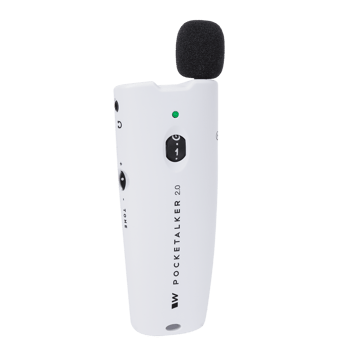
Photo: Williams AV
The Pocketalker 2.0 is probably the easiest of these devices to understand.
It is a small handheld amplifier with an integrated microphone. The user plugs in headphones or earbuds, points the microphone toward the sound they want to hear, and adjusts the volume and tone.
An external microphone can also be connected and placed closer to the person speaking or near a television.
Its biggest advantage is simplicity.
There is almost no learning curve.
This makes it particularly attractive for an elderly patient, someone with limited dexterity, or someone who only needs amplification occasionally.
The large controls are much easier to manipulate than a small hearing aid.
Its main disadvantage is that it remains a relatively basic amplifier.
It does not provide the sophisticated automatic processing, frequency-specific programming, or advanced directional systems of a modern hearing aid.
For one-to-one conversation, television, hospital use, or occasional communication, however, it is a very practical device.
Typical Canadian price: approximately $390–445 CAD.
10.2 Bellman Maxi Pro
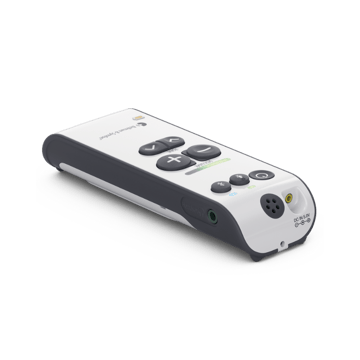
Photo: Bellman & Symfon
The Bellman Maxi Pro moves one step further toward modern digital hearing technology.
It is still a handheld amplifier with large, easy-to-use buttons, but it includes more advanced digital processing, including noise and feedback reduction and adjustable sound characteristics.
It also includes Bluetooth, allowing it to connect to compatible phones and other devices.
Its main strength is the combination of modern processing with relatively simple controls.
This may be a good option for someone who wants better sound processing than a basic amplifier but does not want to navigate a complicated smartphone application.
Its large controls can also be useful for someone with reduced vision or hand dexterity.
The main disadvantage is that it is more expensive than a basic personal amplifier, while still requiring the user to carry a separate handheld device.
Typical Canadian price: approximately $280–435 CAD, depending on the retailer and package.
10.3 BeHear ACCESS Model II
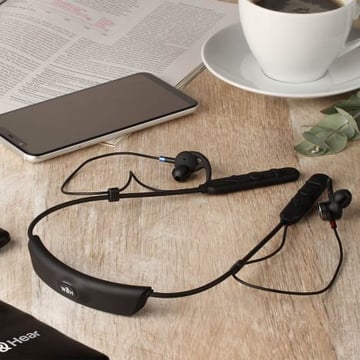
Photo: BeHear / Alango
The BeHear ACCESS Model II is quite different from a traditional personal amplifier.
It looks more like a Bluetooth neckband headset.
It uses multiple microphones and digital processing and provides noise reduction, tone adjustment, and several directional microphone modes.
A smartphone application can also be used to personalize the sound.
This makes it much closer to a modern hearable, meaning a consumer audio product that combines some features traditionally associated with hearing aids.
Its biggest advantage is flexibility.
A technically comfortable user can use the same device for face-to-face conversations, telephone calls, video calls, music, and other audio.
The disadvantage is complexity.
For someone who simply wants to press one button and hear a family member better, all of these additional options may actually make the device less convenient.
Its rechargeable battery also requires more frequent charging than some simpler personal amplifiers.
Typical Canadian price: approximately $380–400 CAD.
11. Which Type Should You Choose?
The choice depends mainly on the situation in which amplification is needed.
For an elderly parent who occasionally struggles to hear family members, television, or medical staff, simplicity should probably be the priority. A device similar to the Pocketalker can be extremely practical.
For someone who wants simple controls but also wants Bluetooth and somewhat more sophisticated digital processing, a device such as the Bellman Maxi Pro may make more sense.
For someone comfortable with smartphones who wants directional microphones, Bluetooth, and more individualized adjustment, a more sophisticated hearable such as the BeHear ACCESS may be preferable.
There is no single best personal amplifier for everyone.
The best device is the one that solves the specific listening problem while remaining easy enough that the person will actually use it.
12. Personal Amplifiers Are Not Simply “Cheap Hearing Aids”
That description misses their real value.
A personal amplifier can sometimes perform a specific job more conveniently than a conventional hearing aid.
A handheld amplifier can be given to a hospitalized patient within seconds. A microphone can be placed beside a television. An external microphone can be positioned directly beside the person speaking.
These are situations where simplicity can be an advantage.
At the same time, a personal amplifier is generally not designed to provide seamless, individualized hearing from morning until night.
The best way to think about personal amplifiers is as targeted listening tools rather than inexpensive replacements for every type of hearing aid.
For the right person and the right listening situation, they can be remarkably effective.
13. Conclusion
Personal sound amplification devices range from very simple pocket amplifiers to sophisticated digital hearables with Bluetooth, directional microphones, noise reduction, and personalized sound processing.
For occasional listening difficulties, television, one-to-one conversations, meetings, or people who find conventional hearing aids difficult to manipulate, a well-designed personal amplifier can be a very useful and relatively affordable solution.
The key is to choose the device according to the listening problem rather than simply buying the product with the most amplification.
Look for appropriate frequency adjustment, control of loud sounds, good microphone performance, comfort, battery life, and ease of use.
For people who require amplification throughout most of the day or who have more significant hearing loss, professionally fitted hearing aids still provide a level of precision and adaptability that personal amplifiers generally cannot match.
14. References
1. Reed NS, Betz J, Kendig N, Korczak M, Lin FR. Personal Sound Amplification Products vs a Conventional Hearing Aid for Speech Understanding in Noise. JAMA. 2017;318(1):89–90. doi:10.1001/jama.2017.6905.
2. Cho YS, Park SY, Seol HY, et al. Clinical Performance Evaluation of a Personal Sound Amplification Product vs a Basic Hearing Aid and a Premium Hearing Aid. JAMA Otolaryngology–Head & Neck Surgery. 2019;145(6):516–522. doi:10.1001/jamaoto.2019.0667.
3. Chen CH, Huang CY, Cheng HL, et al. Comparison of personal sound amplification products and conventional hearing aids for patients with hearing loss: A systematic review with meta-analysis. EClinicalMedicine. 2022;46:101378. doi:10.1016/j.eclinm.2022.101378.
4. Maidment DW, Nakano K, Bennett RJ, Goodwin MV, Ferguson MA. What's in a name? A systematic review and meta-analysis to assess the effectiveness of non-medical amplification devices in adults with mild and moderate hearing losses. International Journal of Audiology. 2025;64(2):111–120. doi:10.1080/14992027.2024.2321184.

Joe Saliba, MD
Dr. Joe Saliba is an ENT surgeon specialized in neuro-otology and medical director at ODYO. He treats patients with various ear and skull base disorders, ranging from hearing loss and vertigo to vestibular schwannomas and cochlear implants.