

What Is a Sigmoid Sinus Diverticulum?
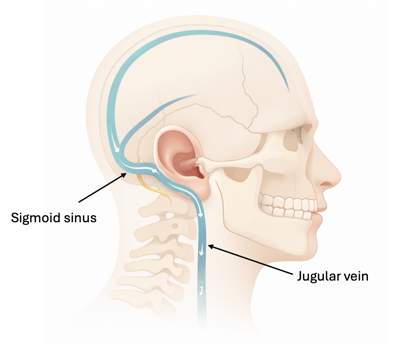
The sigmoid sinus is a large venous channel inside the skull. It drains blood from the brain toward the internal jugular vein in the neck. Anatomically, it runs in a bony groove just behind the ear, within the mastoid bone (the body bulge behind the ear).
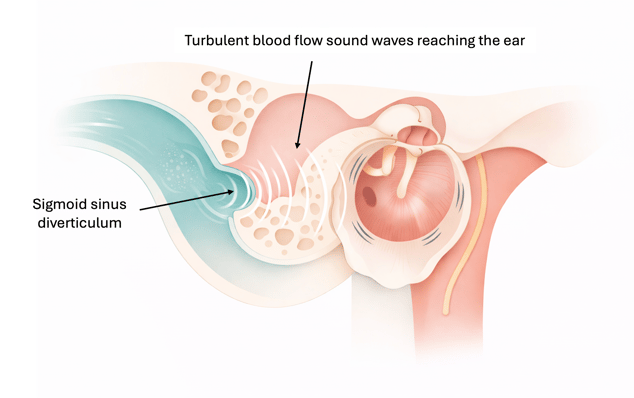
A diverticulum is an outpouching or bulge of a venous structure (it can happen in the bowels too and in other hollow structures). In this condition, part of the sigmoid sinus wall protrudes outward through a defect in the surrounding bone.
In simple terms:
- The bone over the vein is thin or missing.
- The vein bulges out.
- Turbulent blood flow develops.
- The turbulent flow sound waves travel in the mastoid bone and reach the middle ear and inner ear.
- The patient hears their heartbeat in the ear.
This is a mechanical problem.
It is not a tumor.
It is not an infection.
It is not a brain disorder.
Relevant Anatomy
The sigmoid sinus sits:
- Behind the middle ear
- Inside the mastoid bone, surrounded by air cells (air pockets in the mastoid bone behind the ear)
- Covered normally by a thin layer of bone
When that bone is absent or eroded, the venous wall is exposed directly to the mastoid cavity. That proximity allows vascular noise to transmit directly to the inner ear.
What Causes It? Pathophysiology explained.
The exact cause is still debated, but clinically, several mechanisms are likely involved.
What is clear:
The sound comes from turbulent venous blood flow transmitted directly to the cochlea.
Venous Hypertension (High Venous Pressure)
This is common. Increased pressure in the venous system can cause the sinus wall to bulge outward over time.
This is often seen in patients with idiopathic intracranial hypertension (IIH). This is a condition where pressure inside the skull is elevated without a tumor or blockage causing it. It most commonly affects young women with recent weight gain. Patients may experience headaches, visual changes, and sometimes pulsatile tinnitus. IIH must be recognized early because untreated pressure can threaten vision, but it is often reversible with weight loss and medical treatment.
Congenital Bone Thinning
Some patients are simply born with thinner mastoid bone overlying the sinus. Over time, the already thin bone completely erodes with the constant pounding of the blood in the vein.
Chronic Turbulent Flow
Once a small defect forms, altered flow patterns can progressively enlarge the diverticulum.
Who Develops This?
The classic patient that we see with a sigmoid sinus diverticulum would be:
- Female
- 20–50 years old
- Right-sided pulsatile tinnitus
Right-sided involvement is more common because the right sigmoid sinus is typically dominant (larger and carrying more blood flow).
Men can absolutely develop this — just less frequently.
Clinical Presentation
The hallmark symptom is pulsatile tinnitus
This is rhythmic noise synchronized with the heartbeat.
Patients describe:
- “Whooshing”
- “Thumping”
- “Heartbeat in my ear”
- Worse when lying down
Important clinical clue:
The sound often decreases or stops when the patient compresses the neck on the same side.
This maneuver temporarily reduces venous flow, confirming a vascular origin.
Hearing is usually normal. Ear exam is typically normal. This is a structural problem hiding behind an otherwise normal ear.
How to Diagnose a Sigmoid Diverticulum?
Every patient with pulsatile tinnitus deserves proper evaluation. Never assume it is benign.
History
Key questions:
- Is it heartbeat-synchronous?
- Does neck compression reduce it?
- Any vision changes?
- Any prior head trauma?
- Any history of increased intracranial pressure?
Physical Exam
- Examining the ear with the microscope (usually normal)
- Auscultation over the neck and skull (sometimes we can hear the turbulent blood flow)
- Reduction of the pulsatile tinnitus with manual pressure on the neck (on the same side)
- Fundoscopic exam (type of eye exam) if intracranial hypertension suspected. This is done with an ophtalmologist.
Imaging
Imaging is mandatory.
CT Temporal Bone (High-Resolution)
This is the best imaging test to confirm the diagnosis. It allows:
-
- Identifying the bony defect
- Visualizing the diverticulum
- Evaluating the mastoid anatomy
MR Venography (MRV)
Sometimes, in complex cases, an MRV can be ordered. It is best for:
-
- Assessing venous dominance
- Ruling out venous sinus thrombosis
- Evaluating transverse sinus stenosis
Audiogram
Usually normal, but performed to exclude other causes.
Evaluation for Intracranial Hypertension
If symptoms suggest IIH:
- Neuro-ophthalmology exam
- Possibly lumbar puncture
- Generally a neurology referral is warranted.
This is not routine, but based on patient evaluation.
Treatment: What can be Done?
What's important to remember is that this condition is benign, and not dangerous. Treatment is entirely elective (optional) and depends on symptom severity.
1. Observation
If symptoms are mild and imaging confirms the diagnosis, observation is reasonable.
This condition is not dangerous by itself.
2. Medical Therapy
There is no medication that corrects the diverticulum itself.
If IIH is present:
- Weight loss
- Acetazolamide (reduces cerebrospinal fluid production)
But this treats the pressure — not the structural defect.
3. Surgical Treatment
When symptoms are severe and clearly correlate with imaging, surgery is highly effective.
Sigmoid Sinus Resurfacing and Mastoid Obliteration
The goal of the surgery is to remove the diverticulum and eliminate blood flow turbulence, correct the bony defect, and block sound transmission.
This is done through a mastoidectomy approach:
- The diverticulum is exposed and reduced
- The bony defect is reconstructed using bone cement or autologous (from the patient) bone paté
- The mastoid bone is obliterated (filled) with abdominal fat or bone paté
Success rates are high — often 80–90% complete resolution in well-selected patients.
Risks of Surgery
As with any temporal bone surgery:
- Bleeding (this is a venous sinus)
- Sinus thrombosis (clot formation), although rare
- Infection
- Persistent tinnitus (if cause was misidentified)
Patient selection is everything.
When to Seek Evaluation
Patients should seek evaluation if:
- They hear a rhythmic heartbeat sound
- The sound is unilateral (one ear)
- It is new or worsening
- They have associated vision changes
Never ignore pulsatile tinnitus.
Most causes are benign, but some are not.
A proper ENT and radiologic evaluation is essential.
Final Thoughts
Sigmoid sinus diverticulum is a structural, venous cause of pulsatile tinnitus that is frequently underdiagnosed.
When properly identified and appropriately treated, it is one of the most gratifying conditions to manage in otology.
The key is careful evaluation, correct imaging, and thoughtful patient selection.
If you hear your heartbeat in your ear, do not dismiss it. Seek an experienced ENT assessment. Accurate diagnosis makes all the difference.

Joe Saliba, MD
Dr. Joe Saliba is an ENT surgeon specialized in neuro-otology and medical director at ODYO. He treats patients with various ear and skull base disorders, ranging from hearing loss and vertigo to vestibular schwannomas and cochlear implants.